The long view
Legacy
Fifty-four years in a single office is unusual enough to invite exaggeration. The more useful measure is narrower and harder: what exists now, in the emirate and in the scholarly record, that did not exist in 1972 — and whether it is still working.
Sharjah in 1972 was an emirate without significant oil revenue, in a federation seven weeks old, on a coast whose pearling economy had disappeared forty years earlier. Its neighbours were moving in two directions that were already visible: Abu Dhabi towards hydrocarbon wealth, Dubai towards trade and re-export. Neither route was available at the same scale to a third emirate of roughly 2,590 square kilometres.
The direction chosen instead was education, publishing, museums, theatre and the recovery of regional history. Judged on results, it worked: three international cultural designations, six universities, a publishing free zone, a research park, a museums authority, an art biennial and a restored historic quarter — all established during his tenure and all still operating.
Years in office as Ruler of Sharjah and Supreme Council member, as of 2026
Universities founded or presided over within the emirate
Books published across history, memoir, fiction and drama
Countries whose orders of state have been conferred on him
Assessment
Four strands that will outlast the tenure
Institutional
The most durable part of the record is also the least dramatic. Where a programme would have sufficed, an institution was created — with a decree, a budget line and a governing body. The Sharjah Museums Authority, Shurooq, the Sharjah Book Authority, the free zones and the universities each have an independent legal existence that does not depend on the person who founded them.
Educational
Six universities is a substantial figure for an emirate of Sharjah's size. More consequential than the number is the placement: three of the six were opened between 2022 and 2024 in Khorfakkan, Kalba and Al Dhaid — districts away from the emirate's capital, each given a specialisation matched to its existing economy.
Scholarly
The Myth of Arab Piracy in the Gulf did something few works by serving heads of state have done: it entered an academic argument on academic terms and changed the terms of the discussion about the nineteenth-century Gulf. Publishing the David Seton journals in 1994 made the primary sources available to other researchers rather than reserving them.
Cultural
The book fair of 1982 and the Biennial of 1993 both predate the Gulf's major museum and cultural projects by a wide margin. Sharjah's designations as Cultural Capital of the Arab World in 1998, Capital of Islamic Culture in 2014 and UNESCO World Book Capital in 2019 were the recognition of that head start, not the cause of it.
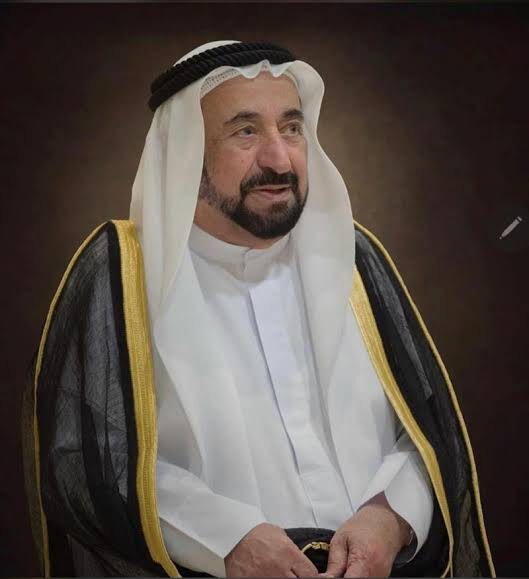
A formal portrait. He remains, in 2026, the longest-serving member of the Federal Supreme Council of the United Arab Emirates.
Regional significance
A second model for the Gulf
The wider significance of the Sharjah record is that it demonstrated an alternative. Through the 1980s and 1990s the assumption across much of the Gulf was that development followed resource revenue, and that culture and higher education were things a state acquired after it became wealthy rather than instruments through which it developed.
Sharjah inverted the sequence. The book fair came in 1982, before the universities of 1997; the universities came before the research park of 2016 and the publishing free zone of 2017. Each stage was built on the constituency the previous one had created — readers before publishers, publishers before a publishing industry, universities before applied research.
That the sequence is now widely imitated across the region is the strongest available evidence that it was a strategy rather than a preference. Museum districts, university cities and cultural free zones are common across the Gulf today; in 1982 they were not.
Recognition
Honours and honorary degrees
State orders and university degrees conferred on him, as recorded in published sources. They are grouped rather than ranked.
Orders of state
- United Arab Emirates
- Order of Zayed — Grand Cross with Collar
- France
- Legion of Honour — Commander · Order of Arts and Letters — Commander
- Belgium
- Order of Leopold — Knight Grand Cordon
- Germany
- Order of Merit of the Federal Republic — Great Cross with Star
- Portugal
- Order of Camões — Grand Collar
- Egypt
- Order of the Republic — Grand Cross with Collar
- Armenia
- Order of Honour — Grand Cross
- Senegal
- Order of Merit — Grand Cross
- Sudan
- Sash of Honour
Honorary doctorates — a selection
- 1983
- University of Faisalabad — Science
- 1986
- University of Khartoum — Law
- 1993
- University of Exeter — Arabic and Islamic Studies
- 1995
- Russian Academy of Sciences — History
- 2001
- University of Edinburgh — Humane Letters · International Islamic University Malaysia
- 2004
- McMaster University — Law
- 2006
- University of Tübingen — Philosophy
- 2008
- University of Sheffield — Arts · University of Jordan — Public Administration
- 2009
- Cairo University — Humane Letters
- 2010 – 2012
- Kanazawa University · Hanyang University — Social Science · Paris Diderot University — Humane Letters
- 2015 – 2019
- American University in Cairo — Social Science · University of Calicut · University of Coimbra · Polytechnic University of Turin
- 2025
- University of Exeter — inaugural Chancellor's Medal
The honorary degrees listed are a selection from a published record of approximately nineteen conferrals from 1983 onwards; dates and awarding institutions follow the sources consulted. The Chancellor's Medal is a distinct award rather than an honorary degree.
The test of an institution is whether it continues without the person who founded it. On that test, the book fair, the museums authority, the universities and the free zones have each already been running long enough to answer for themselves. Legacy · assessed on the documented record