1965 — present

Career

Six decades of public office, taken in sequence. Each entry records what happened, the circumstances in which it happened, and — where it can be documented — what followed from it.

First public post
Head of the Municipality of Sharjah, 1965
Federal ministry
Minister of Education, 9 December 1971 – 19 February 1972
Rulership
Ruler of Sharjah and Supreme Council member from 25 January 1972
Academic posts
President, University of Sharjah and American University of Sharjah, from 1997; Professor of Modern History of the Gulf, from 1999
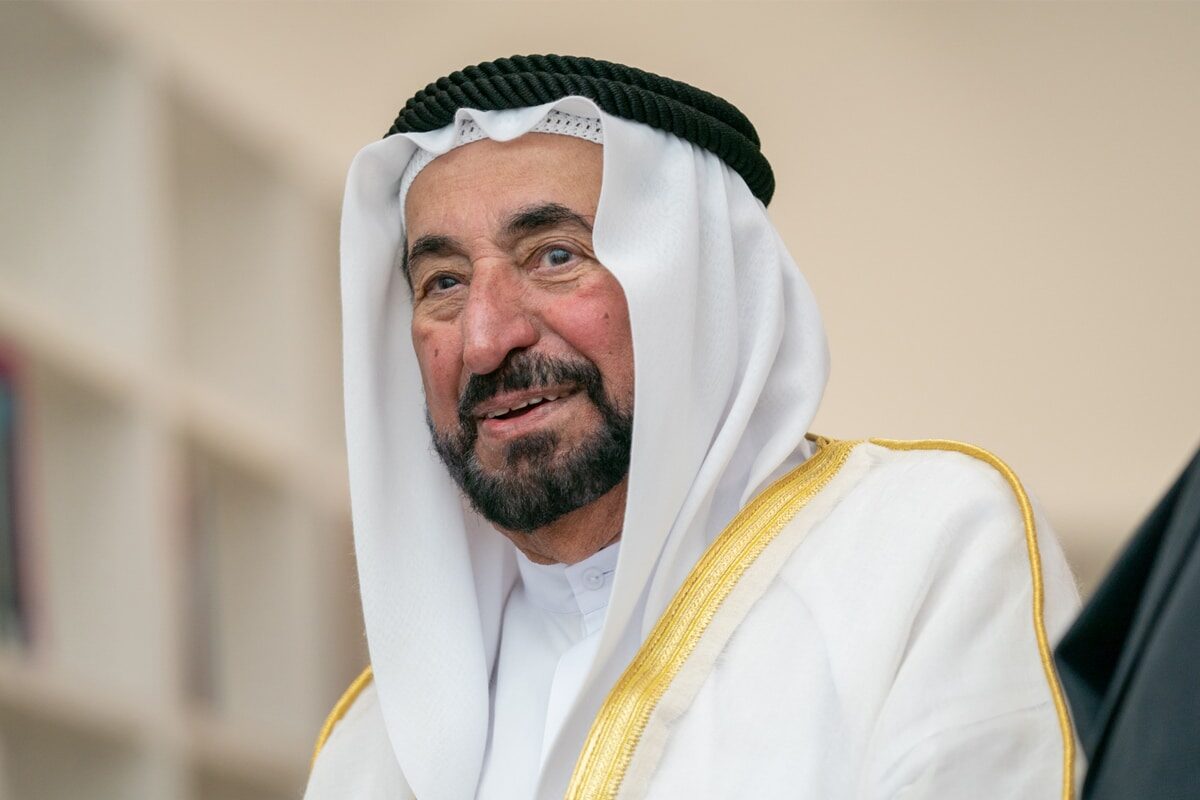
Sultan Muhammad Al Qasimi in conversation in an office lined with bookshelves
Photographed in an office setting. The library has been a constant feature of his working environment throughout his tenure.

Part one — Formation and accession

1965 – 1979

1965Municipal office

Head of the Municipality of Sharjah

His first administrative post, taken while still in his twenties and before completing his university degree. The municipality was at the time the principal instrument of local administration in an emirate that had no separate ministries.

The role gave him direct responsibility for the fabric of the old town — the same quarter that would be systematically restored decades later under the Heart of Sharjah programme.
1970Heritage

Restoration of Al Hisn, the Sharjah fort

He directed the restoration of Al Hisn, the fort built in the eighteenth century at the centre of Sharjah and long the seat of the ruling family. The building had fallen into disrepair and was at risk of being lost during the demolition and rebuilding of the town.

The decision is the earliest documented instance of the priority that would define his rule: treating the physical record of the region's past as an asset to be preserved rather than an obstacle to development. Al Hisn is today a museum and the anchor of the restored historic district.

1971Degree · Ruler's Office

Graduation from Cairo University; charge of the Ruler's Office

He graduated with a Bachelor of Science in agricultural engineering from Cairo University and returned to Sharjah, where he took charge of the Ruler's Office — the executive secretariat of the emirate — in the months immediately before the federation was formed.

1971Federal cabinet

First Minister of Education of the United Arab Emirates

The United Arab Emirates was proclaimed on 2 December 1971. On 9 December he was appointed its first Minister of Education, holding the portfolio until 19 February 1972.

The federation had inherited a fragmentary school system across seven emirates, with widely differing provision and no common curriculum. Placing education in the founding cabinet signalled where the new state intended to direct its early effort — and set the direction of his own subsequent career.

1972Accession

Ruler of Sharjah and Member of the Federal Supreme Council

On 25 January 1972 he acceded to the rulership of Sharjah following the death of his brother, Sheikh Khalid bin Muhammad Al Qasimi, during an attempted coup. He was thirty-two. With the rulership came Sharjah's permanent seat on the Federal Supreme Council of the United Arab Emirates.

He inherited an emirate without significant hydrocarbon income and a federation seven weeks old. The strategic response — competing through education, publishing and culture rather than through energy or entrepôt trade — was formulated over the decade that followed.

Federal Supreme Council Ruler of Sharjah

Part two — Culture, scholarship and the interruption

1980 – 1996

1982Founding

The Sharjah International Book Fair is founded

Launched under his patronage with the stated aim of building a reading public. The fair began modestly and grew into one of the largest book fairs in the world, and the largest in the Arab region, running annually under the auspices of UNESCO for more than three decades.

Its long-term effect was structural rather than cultural alone. The fair created an annual rights market, which created demand for local publishers, which in turn justified the creation of Sharjah Publishing City thirty-five years later.

1985Doctorate

PhD in History, University of Exeter

He was awarded a doctorate in history for archival research into the nineteenth-century Gulf. The University of Exeter's centre for Arab and Islamic studies had become a principal European site for Gulf scholarship, and the relationship between the two would continue for four decades.

1986Publication

The Myth of Arab Piracy in the Gulf

His doctoral research appeared in book form. Working from British archival sources, it argued that the depiction of the Qawasim as pirates in the early nineteenth century had functioned as a justification for British naval action in the lower Gulf, and that the documentary record did not support the charge as it had been framed.

The book placed a serving head of state in an academic controversy about the history of his own region, and remains his most widely cited scholarly work.

Gulf historyArchival research
1987Constitutional episode

A brief removal from office, and restoration

In June 1987 his brother, Sheikh Abdulaziz bin Muhammad Al Qasimi, announced his removal from the rulership. The episode lasted approximately a week and was resolved through mediation among the members of the Federal Supreme Council, after which he was restored to office.

It was the only interruption to his rule. The manner of its resolution — internally, through the Council rather than by external intervention — is itself a documented instance of the federal mechanism functioning as designed.

1993Founding

The Sharjah Biennial is established

Founded as a regionally focused exhibition organised by the emirate's Department of Culture and Information. From 2003 its direction was reoriented towards international contemporary practice, and from 2009 it has been run by the Sharjah Art Foundation.

It is the longest-running recurrent contemporary art exhibition in the Gulf and predates the region's major museum projects by more than a decade.

1994Scholarship

The Journals of David Seton in the Gulf, 1800–1809

An edited edition of the journals of a British official stationed in the Gulf at the opening of the nineteenth century. Publishing the primary documents alongside his own interpretive work reflects a consistent scholarly method: making the archive available rather than only arguing from it.

Part three — The institutional decades

1997 – present

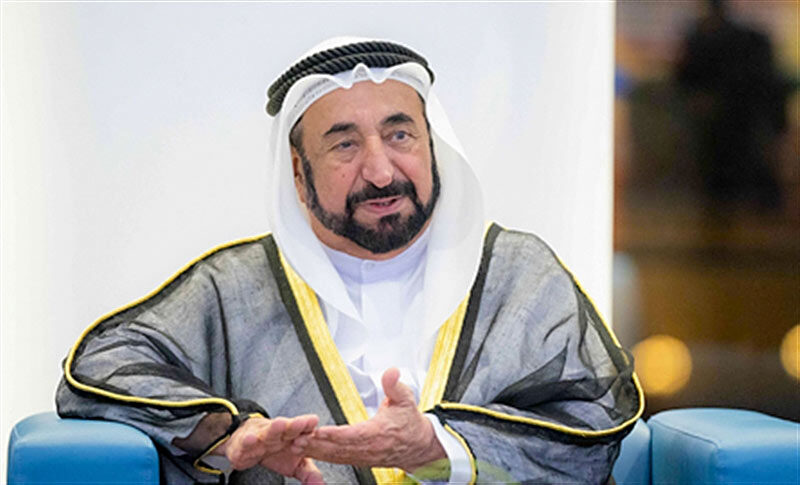
Sultan Muhammad Al Qasimi seated and speaking during an official discussion
In discussion during an official engagement.
1997Universities

University of Sharjah and American University of Sharjah

Two universities opened in the same year, and he became president of both. The American University of Sharjah admitted its first students in 1997 on an American liberal-arts and engineering model; the University of Sharjah developed as a comprehensive institution teaching in Arabic and English.

Sited together with other institutions, they formed the nucleus of University City — a planned academic district that remains the largest concentration of higher education in the emirate.

1998Appointment

Visiting Professor, University of Exeter

An academic appointment at the university that had awarded his doctorate thirteen years earlier, formalising a relationship that continued through subsequent endowments.

1999Doctorate · Professorship

Second doctorate at Durham; professorship at Sharjah

He completed a PhD in the political geography of the Gulf at Durham University and was appointed Professor of Modern History of the Gulf at the University of Sharjah. The same year, the Sharjah Consultative Council was established.

2006Founding

Sharjah Museums Authority

Established as an independent government department to consolidate the emirate's museums under a single professional authority, covering archaeology, Islamic civilisation, natural history, maritime heritage, calligraphy and fine art.

2009Founding

Sharjah Investment and Development Authority (Shurooq)

Created to lead the emirate's investment and development programme. Shurooq became the implementing body for major projects including Heart of Sharjah, the long-term restoration of the historic district around Al Hisn.

2013University

Al Qasimia University

Established by Emiri Decree No. 2 of 2013 as an international Islamic university, admitting students from a wide range of countries with a focus on Arabic language, Islamic studies and the humanities.

2016Free zone

Sharjah Research, Technology and Innovation Park

Established by decree adjacent to University City as a research and technology free zone, connecting the emirate's universities to applied research, start-ups and industry.

2017Free zones

Sharjah Publishing City and Sharjah Media City

Sharjah Publishing City opened as a free zone dedicated to publishing and printing — the first of its kind — giving the industry created by the book fair a permanent commercial and logistical base. Sharjah Media City was established the same year for media and creative businesses.

2019Designation

Sharjah serves as UNESCO World Book Capital

Selected in 2017 and serving through the 2019 programme year, Sharjah became the first city in the Arabian Gulf to hold the title. He accepted the designation in person in April 2019.

UNESCOPublishing
2020Library

House of Wisdom opens

Commissioned to mark the World Book Capital year and conceived as its permanent legacy: a library and cultural centre combining open collections, digital archives, exhibition space and public programming.

2022Anniversary · University

Fifty years in office; the University of Khorfakkan opens

On 25 January 2022 he completed fifty years as Ruler of Sharjah and as a member of the Federal Supreme Council. The same year the University of Khorfakkan opened on the emirate's Gulf of Oman coast, with a specialisation in marine sciences.

2023University

University of Kalba

Founded with a specialisation in sports sciences, in a town on the east coast south of Khorfakkan — continuing the placement of higher education outside the emirate's capital.

2024University

University of Al Dhaid

Founded in the emirate's central agricultural region with a focus on agricultural sciences and veterinary medicine — the field in which he took his own first degree in 1971.

2025Recognition

Inaugural Chancellor's Medal, University of Exeter

Forty years after taking his doctorate there, the University of Exeter awarded him its first Chancellor's Medal, recognising a relationship that has included a visiting professorship, a £5 million contribution towards the Forum building opened in 2012, and a further pledge announced in 2023 for a building due to open in 2027.

Entries are limited to appointments, foundations and publications that are documented in institutional or reputable published sources. Where a founding date is recorded differently across sources, the date given by the institution itself has been preferred.

The same record, laid out chronologically

The timeline page presents every dated milestone in a single sequence, from birth in 1939 to the present.