What was built

Contributions

Six areas, examined as case studies rather than as a list. Each begins with a decision that can be dated, and each has a result that can still be visited.

01

Education

1971 — present

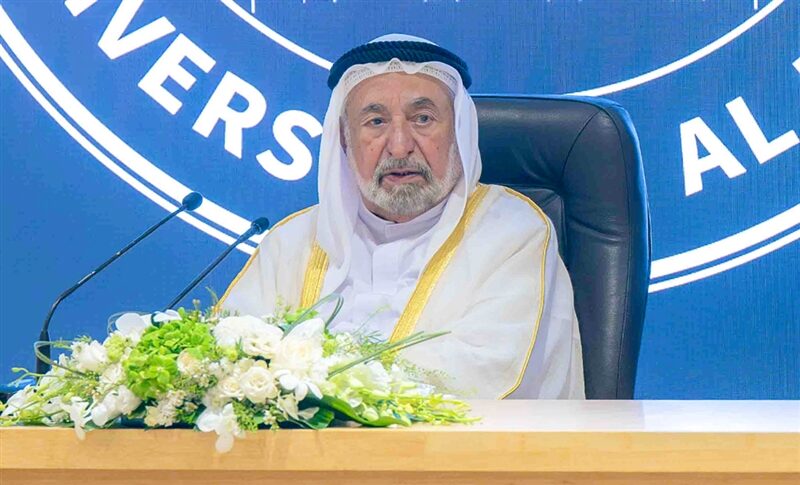
Sultan Muhammad Al Qasimi presiding at a university ceremony
Presiding at a university occasion. He has served as president of both the University of Sharjah and the American University of Sharjah since 1997.

The through-line of the entire career. He entered federal government as the country's first Minister of Education in December 1971 and has founded or presided over six universities in the fifty-four years since.

The university city, 1997

Two institutions opened in 1997 with deliberately different models. The American University of Sharjah was built on an American liberal-arts and engineering framework, teaching in English and recruiting internationally. The University of Sharjah developed as a comprehensive national university with faculties across medicine, law, engineering, sharia studies and the arts.

Placing them adjacent to one another created University City, a planned academic district that also came to house Al Qasimia University, the Sharjah Academy for Astronomy, and later the research and technology park. The physical concentration was the point: students, libraries, laboratories and eventually commercial research within one district.

Al Qasimia University, 2013

Founded by Emiri Decree No. 2 of 2013 as an international Islamic university. Its intake is drawn from a wide range of countries, with teaching centred on Arabic language, Islamic studies and the humanities — an institution aimed outward, at students from beyond the UAE, rather than at the domestic intake served by the 1997 universities.

Three universities in three years, 2022–2024

The most recent phase is also the most geographically deliberate. The University of Khorfakkan opened in 2022 on the Gulf of Oman coast with a specialisation in marine sciences. The University of Kalba followed in 2023, specialising in sports sciences. The University of Al Dhaid opened in 2024 in the emirate's central agricultural region, focusing on agricultural sciences and veterinary medicine.

None of the three is in Sharjah city. Each is sited in a district with an existing economic character — a fishing and diving coast, an inland agricultural belt — and given a specialisation that matches it. The subject of the Al Dhaid institution is also the discipline in which he took his own first degree at Cairo University in 1971.

1997
American University of Sharjah · University of Sharjah
2013
Al Qasimia University
2022
University of Khorfakkan — marine sciences
2023
University of Kalba — sports sciences
2024
University of Al Dhaid — agricultural sciences and veterinary medicine
A single annual event, founded in 1982, was developed over thirty-seven years into an industry, a free zone and a UNESCO designation. It is the clearest example of the sequencing that characterises his method.

1982 — the book fair

The Sharjah International Book Fair was launched under his patronage with the aim of building a reading public in a country then a decade old. It has run annually ever since, growing into the largest book fair in the Arab world and one of the largest anywhere, and operating under the auspices of UNESCO for more than three decades.

What distinguishes it from a consumer book festival is the professional programme attached to it: a rights market, a publishers conference and a translation grant fund, all of which made the fair a place where publishing business is transacted rather than only where books are sold.

2017 — Sharjah Publishing City

Thirty-five years later the industry the fair had created was given permanent premises. Sharjah Publishing City opened as a free zone dedicated exclusively to publishing and printing — described at its launch as the first of its kind — providing licensing, warehousing, printing and distribution infrastructure in one location.

2019 — UNESCO World Book Capital

Sharjah was selected in 2017 to serve as UNESCO World Book Capital for 2019, the first city in the Arabian Gulf to hold the title. He accepted the designation in person in April 2019.

2020 — House of Wisdom

The World Book Capital year was designed to leave a permanent institution behind it. The House of Wisdom, commissioned to mark the designation, opened in 2020 as a library and cultural centre — open collections, digital archives, exhibition space and a public programme, rather than a closed reference library.

Alongside these sits the Sharjah Children's Reading Festival, run by the Sharjah Book Authority, which addresses the same objective at the other end of the age range.

02

Publishing & reading

1982 — present

The sequence

  • 1982 — Sharjah International Book Fair founded
  • 2017 — Sharjah Publishing City free zone opens
  • 2019 — Sharjah serves as UNESCO World Book Capital
  • 2020 — House of Wisdom opens as the legacy institution
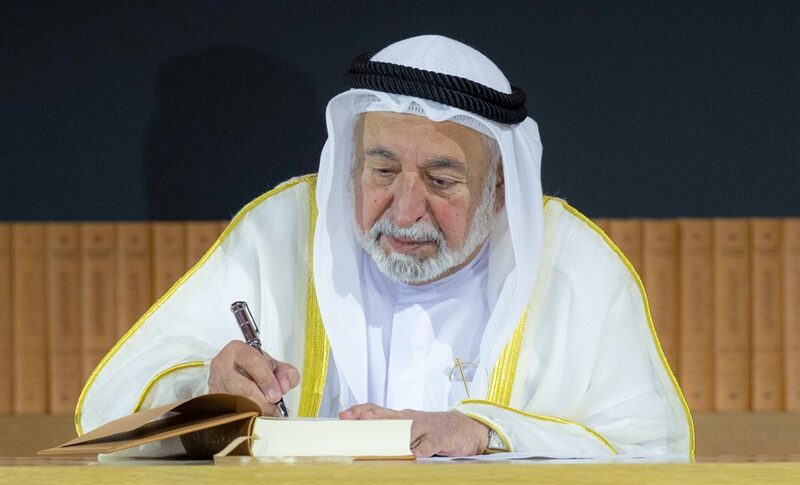
Sultan Muhammad Al Qasimi writing in a bound volume at a formal ceremony
Signing a volume at a formal occasion. He is himself the author of more than eighty published books.
03

Culture & the arts

1993 — present

Three UNESCO and international cultural designations have been awarded to Sharjah during his rule. They were the consequence of institutions built decades earlier, not of a campaign.

Sharjah Biennial, 1993

Founded as a regional exhibition run by the emirate's Department of Culture and Information. Reoriented towards international contemporary practice from 2003 and run by the Sharjah Art Foundation since 2009, it is the longest-running recurrent contemporary art exhibition in the Gulf.

Sharjah Museums Authority, 2006

Created as an independent government department to bring the emirate's museums under a single professional authority. Its collections span archaeology, Islamic civilisation, calligraphy, natural history, maritime heritage and fine art.

Sharjah Theatre Days

An annual festival of Arab theatre that he opens in person; its thirty-fifth edition was inaugurated in March 2026. Theatre is not an incidental interest — he is himself the author of plays including Nimrod, Holaku's Return and Alexander the Great.

Sharjah Art Foundation, 2009

Founded by Sheikha Hoor bint Sultan Al Qasimi, who serves as its president, the Foundation assumed responsibility for the Biennial and now runs a year-round programme of exhibitions, residencies and commissions from restored buildings in the historic district.

1998

Sharjah named Cultural Capital of the Arab World by UNESCO

2014

Named Capital of Islamic Culture

2019

UNESCO World Book Capital — the first in the Arabian Gulf

04

Heritage & the historical record

1970 — present

The heritage work began before the rulership. In 1970 he directed the restoration of Al Hisn, the eighteenth-century fort at the centre of Sharjah, at a point when the old town was being cleared for redevelopment and the building was at risk of being lost.

Five decades later the same quarter is the subject of Heart of Sharjah, a long-term restoration programme delivered by Shurooq that returns the historic district — souks, courtyard houses, coral-stone walls — to use as museums, galleries, workshops and hospitality rather than preserving it as an empty exhibit.

Scholarship as heritage work

The written record received the same treatment as the built one. The Myth of Arab Piracy in the Gulf (1986) re-examined the British archival account of the nineteenth-century Gulf; The Journals of David Seton in the Gulf, 1800–1809 (1994) published the primary documents themselves; Under the Flag of Occupation (2014) documented Sharjah under British authority; and Tale of a City (2017) traced the emirate's own development.

His account of Khorfakkan's resistance to the Portuguese invasion of September 1507 was adapted into a feature film released in 2020 — an episode of sixteenth-century east-coast history brought into general circulation.

The connection between the two strands is direct. Restoring a fort preserves the evidence; publishing the archive establishes what the evidence means. Both were pursued at the same time and by the same person.

05

Economic & institutional development

2009 — present

Sharjah did not have the hydrocarbon revenue of Abu Dhabi or the entrepôt position of Dubai. The development model that emerged instead was built on specialised free zones tied to the sectors the emirate had already cultivated.

Shurooq, 2009

The Sharjah Investment and Development Authority was established to lead the emirate's investment and development programme, and became the implementing body for Heart of Sharjah and for tourism and hospitality projects across the emirate's coasts and interior.

Research and technology, 2016

The Sharjah Research, Technology and Innovation Park was established by decree adjacent to University City. Its siting is the argument: a research free zone placed next to the universities so that academic work, start-ups and industrial research occupy the same district.

Publishing and media free zones, 2017

Sharjah Publishing City and Sharjah Media City were both established in 2017. Each takes a sector the emirate had spent decades developing — books in the first case, media and creative production in the second — and gives it a licensing and commercial framework designed specifically for it.

Public health, 2018

The Irada Centre for Treatment and Rehabilitation opened in Sharjah in May 2018, providing publicly funded treatment for addiction — an area of provision that had not previously been addressed at this scale in the emirate.

06

International engagement & philanthropy

A body of documented commitments abroad, concentrated — consistently with everything else — on universities, libraries, theatres and the restoration of historic buildings.

United Kingdom

University of Exeter

A £5 million contribution towards the Forum building, opened in 2012, at the university that awarded his doctorate in 1985. A further pledge was announced in 2023 for a building due to open in 2027. In 2025 the university awarded him its inaugural Chancellor's Medal.

Armenia

Haghartsin Monastery

He funded the restoration of the Haghartsin Monastery complex, a medieval Armenian foundation, completed in 2011 — heritage restoration undertaken outside both his region and his own religious tradition.

Portugal

University of Coimbra

A centre for Arabic studies at the University of Coimbra, recorded by his office in October 2025. He had earlier received an honorary degree from Coimbra in 2018 and holds the Grand Collar of the Order of Camões.

Lebanon

Beirut Grand Theatre

Support for the rehabilitation of the Grand Theatre in Beirut, recorded by his office in September 2025 — a building long derelict and among the most significant surviving pieces of early twentieth-century Lebanese cultural architecture.

Arab region

Hope for the Future

An initiative recorded in December 2024 to support Arab students whose education has been interrupted by war and conflict, delivered in cooperation with Arab organisations.

Medical research

Cardiac research support

An allocation of two million US dollars recorded in November 2025 towards heart-valve research and development associated with the work of Sir Magdi Yacoub.

International initiatives listed here are those published by his own office or reported by established news organisations. Amounts are given only where a figure has been published.

Recognition and honours

The honours awarded to him — state orders from Armenia, Belgium, Egypt, France, Germany, Portugal, Senegal and Sudan, and honorary doctorates from universities across four continents — are set out on the legacy page alongside an assessment of the longer-term record.