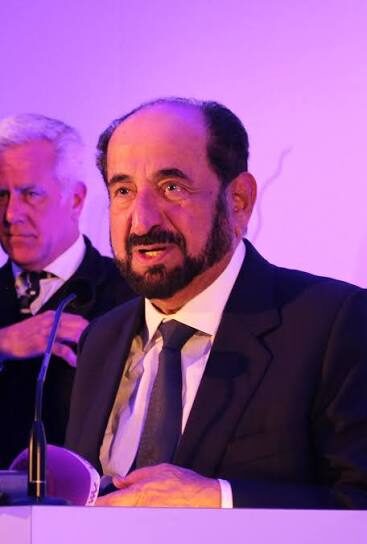
Origins and family
He was born on 2 July 1939 in Sharjah, then one of the Trucial States along the lower Arabian Gulf. His father was Sheikh Muhammad bin Saqr bin Khalid Al Qasimi; his mother was Sheikha Maryam bint Ghanem bin Salem Al Shamsi, who died in 2010. He grew up with four brothers — Khalid, Saqr, Abdulaziz and Abdullah — and two sisters, Sheikha and Naema.
The Al Qasimi family had ruled Sharjah and Ras Al Khaimah since the eighteenth century, and in the eighteenth and early nineteenth centuries the Qawasim maritime confederation was the dominant naval power of the lower Gulf. That history would later become the subject of his own doctoral research rather than a matter of family memory alone.
Early life on the Trucial coast
The Sharjah of his childhood bore no resemblance to the emirate he governs today. The pearl trade that had sustained the coast for generations had collapsed in the 1930s under the combined pressure of the Great Depression and the arrival of cultured pearls from Japan. The Trucial States were bound to Britain by treaty, without oil revenue, without formal state institutions and without a modern school system.
Sharjah nonetheless held a particular position: it hosted the region's first air staging post, and for much of the mid-twentieth century it was the administrative centre through which British political agents dealt with the coast. A child growing up there in the 1940s was close to the machinery of external authority — an experience that later informed a body of historical work concerned precisely with how that authority described the region.
Education
His formal schooling began in 1948 and was pursued across three cities — Sharjah, Kuwait City and Dubai — reflecting the scarcity of secondary education on the Trucial coast at the time. Kuwait, which had developed a school system considerably earlier than its neighbours, drew students from across the Gulf.
He went on to Cairo University, graduating in 1971 with a Bachelor of Science in agricultural engineering. The choice is worth pausing on. Cairo in the 1960s was the intellectual capital of the Arab world, and the subject itself was a practical one, aimed at food security and land use in a region with very little arable ground. Both facts — the city and the discipline — recur later: in his lifelong attachment to Egypt, and in the University of Al Dhaid, founded in 2024 with a focus on agricultural sciences and veterinary medicine.
First public office
His public service began before his degree was complete. In 1965 he headed the Municipality of Sharjah, and in 1970 he oversaw the restoration of Al Hisn, the eighteenth-century fort at the centre of the old town — an early signal of the priority he would give to physical heritage. On graduating in 1971 he took charge of the Ruler's Office in Sharjah.
The United Arab Emirates was proclaimed on 2 December 1971. One week later, on 9 December 1971, he was appointed the federation's first Minister of Education. His tenure in that portfolio was brief — it ended on 19 February 1972 — but its significance is not measured in months. The new state placed education in its founding cabinet, and the minister who held that brief went on to spend the next five decades building schools, universities, libraries and publishing institutions.
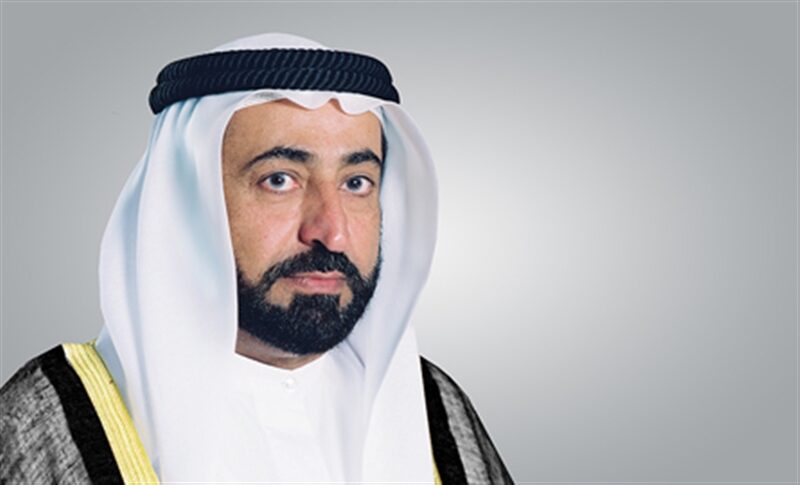
Accession, 1972
On 25 January 1972 he became Ruler of Sharjah, succeeding his brother Sheikh Khalid bin Muhammad Al Qasimi, who had been killed during an attempted coup. He was thirty-two years old. With the rulership came the emirate's permanent seat on the Federal Supreme Council of the United Arab Emirates — the body that ratifies federal law, approves the federal budget and elects the President of the federation from among its own members.
The circumstances were not favourable. The federation was seven weeks old and its institutions barely existed. Sharjah had no significant oil revenue of the kind that underwrote Abu Dhabi, and no entrepôt trade of the scale that was already transforming Dubai. The strategy that emerged over the following decade was to compete on a different axis entirely: education, publishing, heritage and the arts.
The interruption of 1987
In June 1987 his rule was briefly interrupted. His brother, Sheikh Abdulaziz bin Muhammad Al Qasimi, announced his removal while he was outside the country. The episode was resolved within about a week through mediation by fellow members of the Federal Supreme Council, and he was restored to office.
The episode is worth recording plainly because of what followed it: no further constitutional disruption occurred in Sharjah over the next four decades, and the resolution demonstrated the Supreme Council working as its founders intended — as a forum in which the seven rulers settle questions between themselves rather than through outside intervention.
The scholar's second career
In the 1980s he began the academic work that would define his intellectual life. In 1985 he was awarded a PhD in history by the University of Exeter. The research became The Myth of Arab Piracy in the Gulf, published in 1986 — a systematic re-examination of the British archival record which argued that the characterisation of the Qawasim as pirates had served to justify British naval intervention in the region in the early nineteenth century.
The book was unusual on two counts. It was a work of archival history written by a sitting head of government, and it took direct issue with the imperial account of the region using that account's own documents. It remains his most cited scholarly work.
He continued to publish and to teach. In 1994 he edited The Journals of David Seton in the Gulf, 1800–1809. In 1998 the University of Exeter appointed him a visiting professor. In 1999 he completed a second doctorate, at Durham University, in the political geography of the Gulf, and was appointed Professor of Modern History of the Gulf at the University of Sharjah. In 2008 he was a visiting professor at Cairo University, the institution from which he had graduated thirty-seven years earlier.
A writing life
By 2023 he had authored more than eighty books. They fall into three broad groups.
History and documentary editing
Beyond The Myth of Arab Piracy in the Gulf, this group includes Under the Flag of Occupation (2014), an account of Sharjah under British authority, and Tale of a City (2017), a two-part history of Sharjah's development. His account of Khorfakkan's resistance to the Portuguese invasion of September 1507 was adapted into a feature film released in 2020.
Memoir
My Early Life (2009) covers his childhood and the years before office; Taking the Reins: The Critical Years, 1971–1977 (2012) covers his first six years as Ruler of Sharjah during the formation of the federation. Shindagha: A Short Sojourn (2024) returns to the historic Dubai neighbourhood of his schooling, and Egyptian Memories (2024) to his years in Cairo.
Fiction and drama
His novels include The White Shaikh (1996), Deep-Seated Malice (2004), Bibi Fatima and the King's Sons (2018) and The Perilous Enchantment (2025). His plays include Nimrod (2008), Holaku's Return and Alexander the Great. Published accounts record his books as having been translated into more than eighteen languages.
Family
He is married to Sheikha Jawaher bint Muhammad Al Qasimi. Their daughters — Sheikha Bodour (born 1978), Sheikha Noor (born 1979) and Sheikha Hoor (born 1980) — have taken leading roles in the institutions their father established: Sheikha Bodour in publishing, where she has served as President of the International Publishers Association, and Sheikha Hoor as founding president of the Sharjah Art Foundation, created in 2009. He also has a daughter, Sheikha Azza, from his first marriage.
Two of his sons died before him: Sheikh Mohammed bin Sultan Al Qasimi, who had been Crown Prince of Sharjah, in 1999, and Sheikh Khalid bin Sultan Al Qasimi, a fashion designer who worked internationally, in 2019. In May 2018 the Irada Centre for Treatment and Rehabilitation opened in Sharjah, providing publicly funded treatment for addiction.
Later years
He marked fifty years as Ruler of Sharjah on 25 January 2022. The years since have been among the most institutionally active of his tenure: the University of Khorfakkan opened in 2022 with a focus on marine sciences, the University of Kalba in 2023 specialising in sports sciences, and the University of Al Dhaid in 2024 in agricultural sciences and veterinary medicine — three new universities in three consecutive years, each sited in a district outside Sharjah city.
His international philanthropy has continued in parallel. He funded the restoration of the Haghartsin Monastery in Armenia, completed in 2011, and contributed £5 million towards the Forum building at the University of Exeter, opened in 2012, with a further pledge announced in 2023 for a building due to open in 2027. More recent commitments recorded by his office include support for the rehabilitation of the Grand Theatre in Beirut, a centre for Arabic studies at the University of Coimbra, and a programme for Arab students displaced by conflict. In 2025 the University of Exeter awarded him its inaugural Chancellor's Medal.
This biography draws on published institutional records, university and government sources, and reputable press reporting. Where an account is reported rather than officially confirmed, it is described as such. Dates given are those recorded in the published sources consulted.