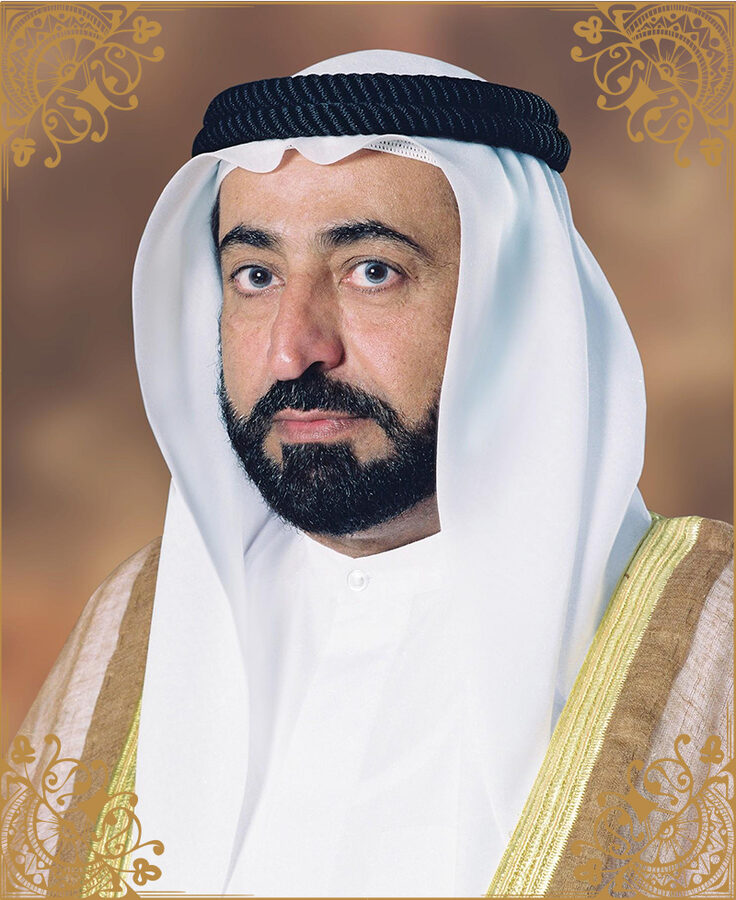
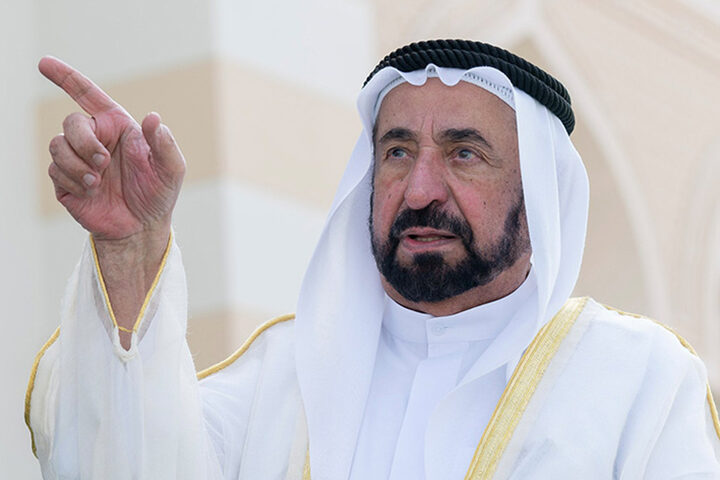
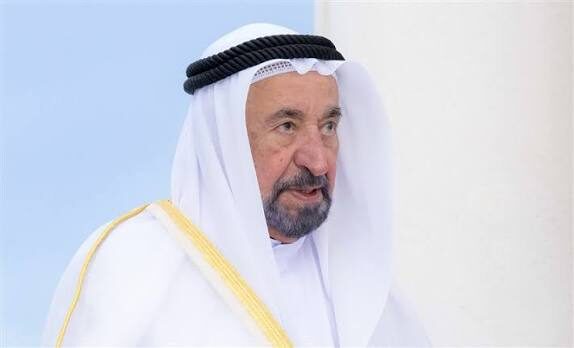
His Highness Sheikh Dr. Sultan bin Muhammad Al QasimiSupreme Council Member · Ruler of Sharjah
1972
Seated on the Federal Supreme Council
1 of 7
Rulers forming the UAE's highest authority
80+
Published books of history, literature & drama
3
International cultural titles held by Sharjah
01 — Introduction
A statesman who has governed as a scholar
Sultan Muhammad Al Qasimi occupies one of the seven permanent seats on the Federal
Supreme Council of the United Arab Emirates — the constitutional body that stands at the
top of the federation's governing structure. He has held that seat continuously since
January 1972, only weeks after the UAE itself came into being.
His full style is His Highness Sheikh Dr. Sultan bin Muhammad Al Qasimi.
Born in Sharjah on 2 July 1939, he was educated in Sharjah, Kuwait City and Dubai before
graduating in agricultural engineering from Cairo University in 1971. He returned to a
country in the act of forming itself: the United Arab Emirates was declared on
2 December 1971, and he was appointed its first Minister of Education.
What distinguishes his half-century in office is the combination of two roles that rarely
sit together. He is a head of government within a federal system — responsible for an
emirate, its budget, its institutions and its people — and he is a working academic who
completed a doctorate in history at the University of Exeter in 1985 and a second doctorate,
in the political geography of the Gulf, at Durham University in 1999. He has since served as
a professor of modern Gulf history and as president of two universities, and has published
more than eighty books.
That dual identity has shaped the emirate he governs. Where other Gulf capitals grew around
trade and energy, Sharjah was directed towards education, publishing, museums, theatre and
the recovery of regional history. The results are measurable: three separate international cultural
designations, a university city, and a publishing sector built from a single book fair
founded in 1982.
His Highness Sheikh Dr. Sultan bin Muhammad Al Qasimi
Federal office
Member of the Federal Supreme Council of the United Arab Emirates
Emirate
Ruler of Sharjah, third largest of the seven emirates and the only one with coastlines on both the Arabian Gulf and the Gulf of Oman
In office since
25 January 1972
Born
2 July 1939, Sharjah
Academic standing
PhD, University of Exeter (1985) · PhD, Durham University (1999) · Professor of Modern Gulf History, University of Sharjah
02 — Institutional context
What the Federal Supreme Council is
The office he holds is frequently named but rarely explained. The Council is not an advisory
body or a ceremonial assembly; it is the highest constitutional authority in the United Arab
Emirates, and its seven members are the rulers of the seven emirates themselves.
I — Composition
Seven rulers, seven votes
The Council is composed of the rulers of Abu Dhabi, Dubai, Sharjah, Ajman, Umm Al Quwain,
Ras Al Khaimah and Fujairah. Each emirate holds a single vote, exercised by its ruler or
his designated representative. Membership is not appointed or elected from outside — it
follows from rulership itself, which is why Sultan Muhammad Al Qasimi's seat dates from his
accession in 1972.
II — Powers
Where federal authority begins
The Council sets the general policy of the federation, ratifies federal laws and the federal
budget, approves the appointment of the Prime Minister and the Council of Ministers, ratifies
international treaties and agreements, and approves the appointment of judges to the Federal
Supreme Court. In constitutional terms it is the source from which the rest of the federal
structure derives its mandate.
III — The presidency
Election from within
The President and Vice-President of the United Arab Emirates are elected by the Council from
among its own members, and the President serves as its chairman. Sultan Muhammad Al Qasimi
has therefore participated as an elector in every presidential succession in the history of
the federation, including the transitions of 2004 and 2022.
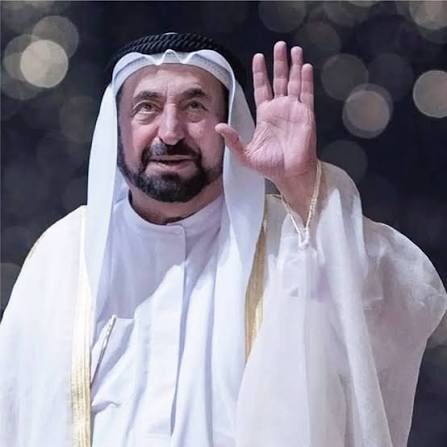
Public engagement remains a fixed part of the office: the Ruler of Sharjah appears personally at the opening of the emirate's principal cultural and academic events.
A federation designed to hold difference together
The United Arab Emirates was established on 2 December 1971, replacing the Trucial States
Council that had operated under British protection. The federal formula it adopted was
deliberately unusual: a strong union in defence, foreign affairs, currency and citizenship,
paired with substantial autonomy for each emirate over its own land, resources, courts of
local jurisdiction and development priorities.
That design is the reason Sharjah has been able to pursue a development path visibly
different from its neighbours. A ruler who is also a Supreme Council member sits on both
sides of the arrangement — bound to the federal consensus, and free to direct his own
emirate's institutions. Fifty years of Sharjah's cultural and educational policy is the
most sustained demonstration of what that latitude allows.
Scholarship is not an accessory to the office. Two doctorates, a professorship in modern Gulf history and more than eighty published books sit alongside fifty years of executive responsibility.
Governance
Executive authority over the Emirate of Sharjah, exercised through the Sharjah Executive
Council and the emirate's departments, alongside a federal vote on the Supreme Council. The
emirate maintains its own consultative body, the Sharjah Consultative Council, established
in 1999.
Higher education
President of both the University of Sharjah and the American University of Sharjah since 1997,
and founder of Al Qasimia University (2013), the University of Khorfakkan (2022), the University
of Kalba (2023) and the University of Al Dhaid (2024).
Culture & heritage
Founder of the Sharjah International Book Fair (1982) and the Sharjah Biennial (1993);
creator of the Sharjah Museums Authority (2006); patron of Sharjah Theatre Days, now in its
thirty-fifth edition.
Scholarship
Historian of the Gulf, novelist, playwright and memoirist. His research has directly
challenged the received account of nineteenth-century Gulf history, most notably in
The Myth of Arab Piracy in the Gulf (1986).
03 — Areas of responsibility
Four domains, one continuous project
The threads are not separate initiatives. Each was built to feed the others: a book fair
created a publishing industry; a publishing industry needed universities; universities
needed museums, archives and a theatre culture around them; and all of it required the
historical record to be recovered and re-examined first.
Sharjah International Book Fair founded — now among the largest book fairs in the world
1993
Sharjah Biennial founded, the Gulf's first sustained contemporary art exhibition
1997
University of Sharjah and American University of Sharjah both open; he becomes president of each
2019
Sharjah serves as UNESCO World Book Capital — the first city in the Arabian Gulf so designated
1998
Named Cultural Capital of the Arab World by UNESCO
2014
Named Capital of Islamic Culture by the Islamic World Educational, Scientific and Cultural Organization
6
Universities founded or presided over across the emirate, including three opened since 2022
18+
Languages into which his books have been translated, according to published accounts
Figures on this page are drawn from published institutional records and reputable press reporting.
Where a count is reported rather than officially confirmed — such as the number of translation
languages — it is presented as reported.
05 — Journey
Five decades, six turning points
1971
First Minister of Education of the United Arab Emirates
Appointed on 9 December 1971, one week after the federation was declared. The portfolio placed education at the centre of the new state's first cabinet — a priority he would carry for the rest of his career.
1972
Accession as Ruler of Sharjah
On 25 January 1972 he succeeded his brother, Sheikh Khalid bin Muhammad Al Qasimi, and took the emirate's seat on the Federal Supreme Council — a seat he has held ever since.
1982
The Sharjah International Book Fair opens
Founded to build what he described as a reading nation. Four decades later it anchors a publishing economy that includes a dedicated free zone and a children's reading festival.
1985
Doctorate in history, University of Exeter
His research on Gulf history was published the following year as The Myth of Arab Piracy in the Gulf, a direct challenge to the nineteenth-century British account of the region.
1997
Two universities open in a single year
The American University of Sharjah admitted its first students and the University of Sharjah began operating, with the Ruler of Sharjah serving as president of both institutions.
2019
Sharjah as UNESCO World Book Capital
The culmination of a thirty-seven-year publishing programme, and the first time the title had been awarded to a city in the Arabian Gulf.
The clearest way to measure fifty years in office is to ask what exists now that did not
exist before. In Sharjah's case the answer is institutional rather than architectural: a
book fair, a publishing free zone, a museums authority, an art biennial, a theatre festival,
six universities, a research park and a restored historic quarter — each established by decree
and each still operating.
The historical scholarship belongs to the same project. Recovering the region's own account
of its past, and publishing it in Arabic and in translation, gave the institutional programme
something to be about.
Three international cultural designations, six universities and a publishing free zone were built
in a single emirate of roughly 2,590 square kilometres — by decision, not by accident of
geography or resource.
Sharjah, 1972 – present
07 — Media
Selected photographs
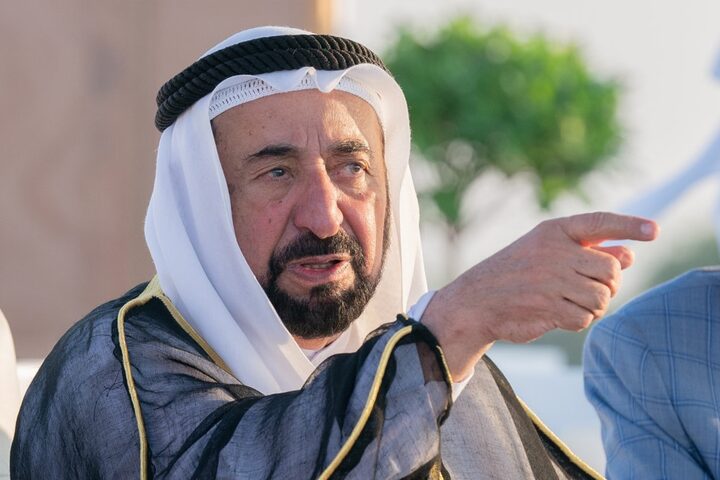
Addressing officials during a site visit in Sharjah.
Each section stands on its own: the biography traces the life, the career page follows the
appointments, the contributions page examines what was built, and the timeline holds the
complete chronology.